
What's Your Story?
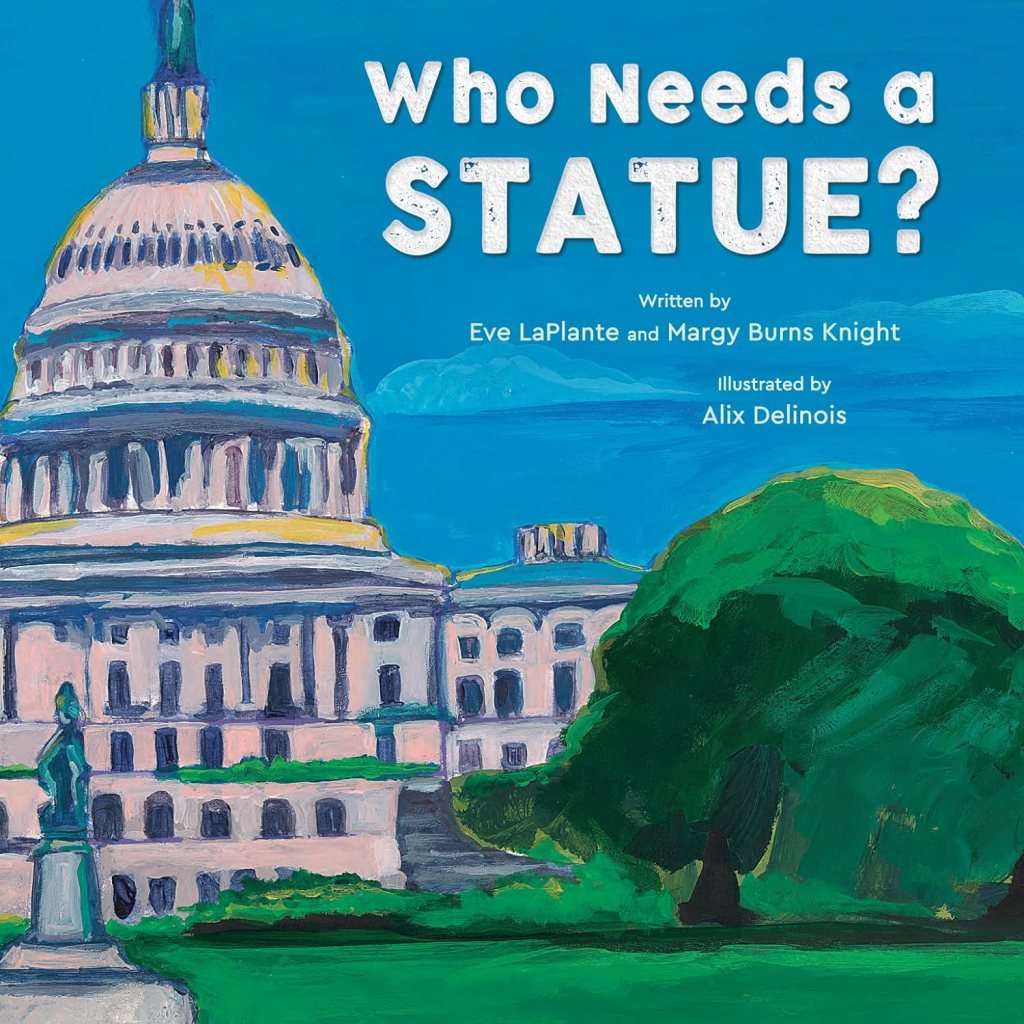
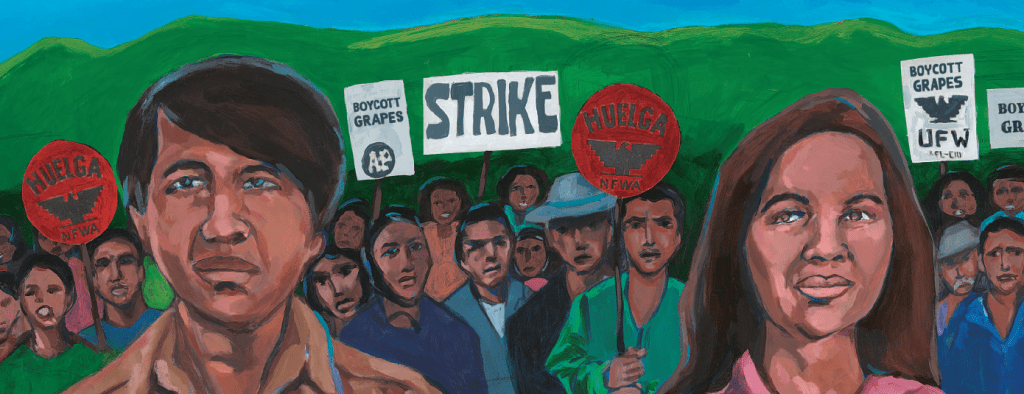
Whose accomplishments are commemorated in a public place, for all to see? Of the 100 statutes that stand in the U.S. Capitol Building in Washington, D.C., contextualizing text notes, nine represent people of color and 12 represent women. After offering brief biographies of a few (Paiute writer Thocmetony Sarah Winnemucca and Montana politician Jeannette Rankin, among others), LaPlante, making a children’s book debut, and Knight (Africa Is Not a Country) introduce sculptures across the country that immortalize people of color and women. A statue at San Jose State University honors sprinters Tommie Smith and John Carlos, who stood on the 1968 Olympic winners’ podium “without shoes as a symbol of poverty” and wearing “beads and scarves around their necks in memory of lynching victims.” A statue in Chicago’s Ping Tom Park represents Judge Laura Cha-Yu Liu, who in 2012 became the first Chinese American elected to public office in Chicago. Thickly stroked paintings by Delinois (Greetings, Leroy) show scenes from the subjects’ lives as well as the statues in their settings, in a reportorial work that opens conversations about public representation. Short biographies of those discussed in the text conclude. Ages 7–10. (Oct.)
I introduce, demonstrate, and have students practice Visual Learning Strategies. Inspired by the three question visual thinking strategies protocol, I will show that this discussion-based teaching and learning strategy not only includes all four domains of language learning, but is an effective tool across the curriculum.
During the VLS workshop I introduce my nonfiction illustrated books, exploring global cultures through the lens of human commonalities — statues, walls, immigrant stories, traditions for welcoming babies, and the daily life of children .
Visual Learning Strategies Are So Much Fun as you Discover Your World!
I will present up to four one hour workshops per day. Workshops are limited to 30 students or one class.
School fees are negotiable
Within Maine
Within 60 miles of Waterville— $800/day
More than 60 miles from Waterville — $800/day plus travel and lodging
New England
Outside of Maine — $1,000/day plus travel and lodging
Beyond New England
$1,000/day plus travel and lodging
Book an Event or Get More Information

BY EVE LAPLANTE & MARGY BURNS KNIGHT ; ILLUSTRATED BY ALIX DELINOIS ‧ RELEASE DATE: OCT. 15, 2024
Deserving but less prominent luminaries shine more brightly here.
Agallery of intrepid American groundbreakers, pathfinders, and activists who have earned commemorative statues.
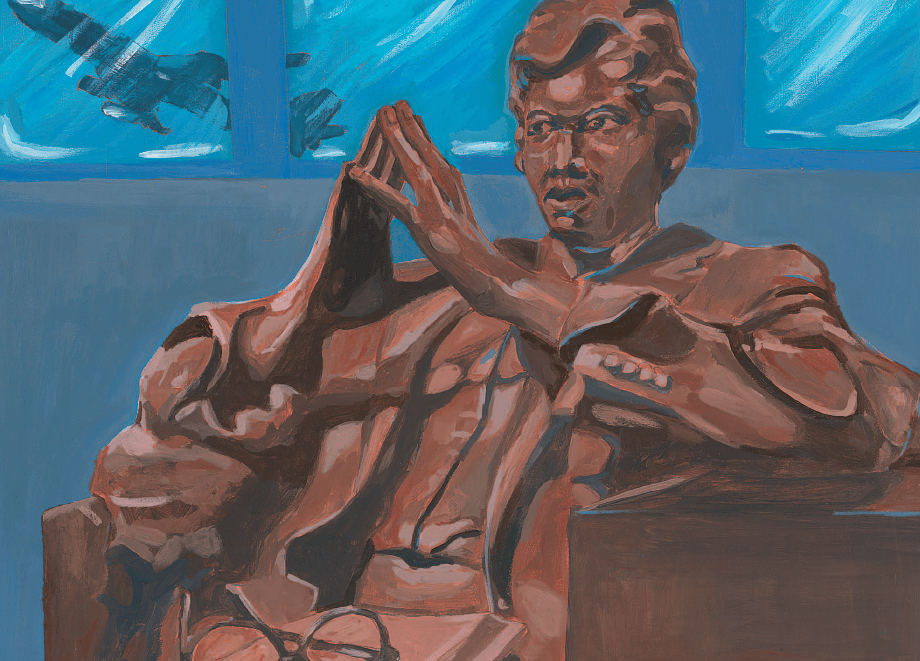
Starting at the U.S. Capitol and ranging as far afield as an airport in Austin, Texas, and a park in Napa, California, the book covers more than a dozen figures—all either women, people of color, or both—who have been immortalized in stone or bronze. Many of the names will likely be unfamiliar to young readers. Beginning with Thocmetony Sarah Winnemucca, the first published Native American woman author, and continuing on past the inspirational likes of Anne Hutchinson (who was banished from colonial Massachusetts for illegally teaching men), comet discoverer Maria Mitchell, and Olympians and activists Tommie Smith and John Carlos, each entry features a brief but sonorous initial annotation and a more detailed one in the backmatter that identifies the statues’ sculptors. Delinois’ painterly images don’t always capture the individual style or character of the monuments the way photos would have, but he does take advantage of his medium to add homey or historical flourishes, such as a view of Deborah Sampson—who dressed in men’s clothes in order to fight in the American Revolution—blasting away at a group of redcoats and an image of a child in a wheelchair seated next to a chatty effigy of Everglades advocate Marjory Stoneman Douglas in a garden near Miami. An oblique closing reference to commemorative statues being removed or replaced in many localities ends this powerful recitation on a cogent note. Deserving but less prominent luminaries shine more brightly here. (Informational picture book. 7-10)
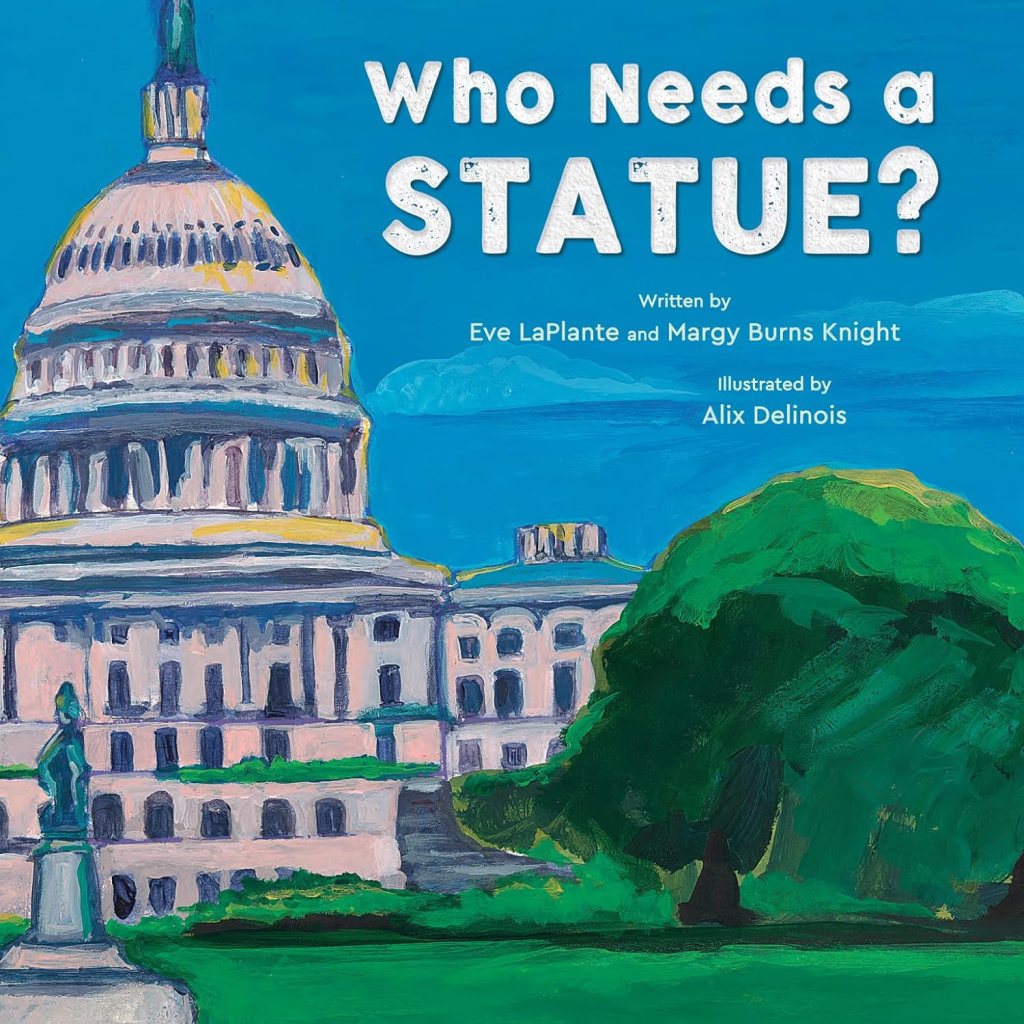
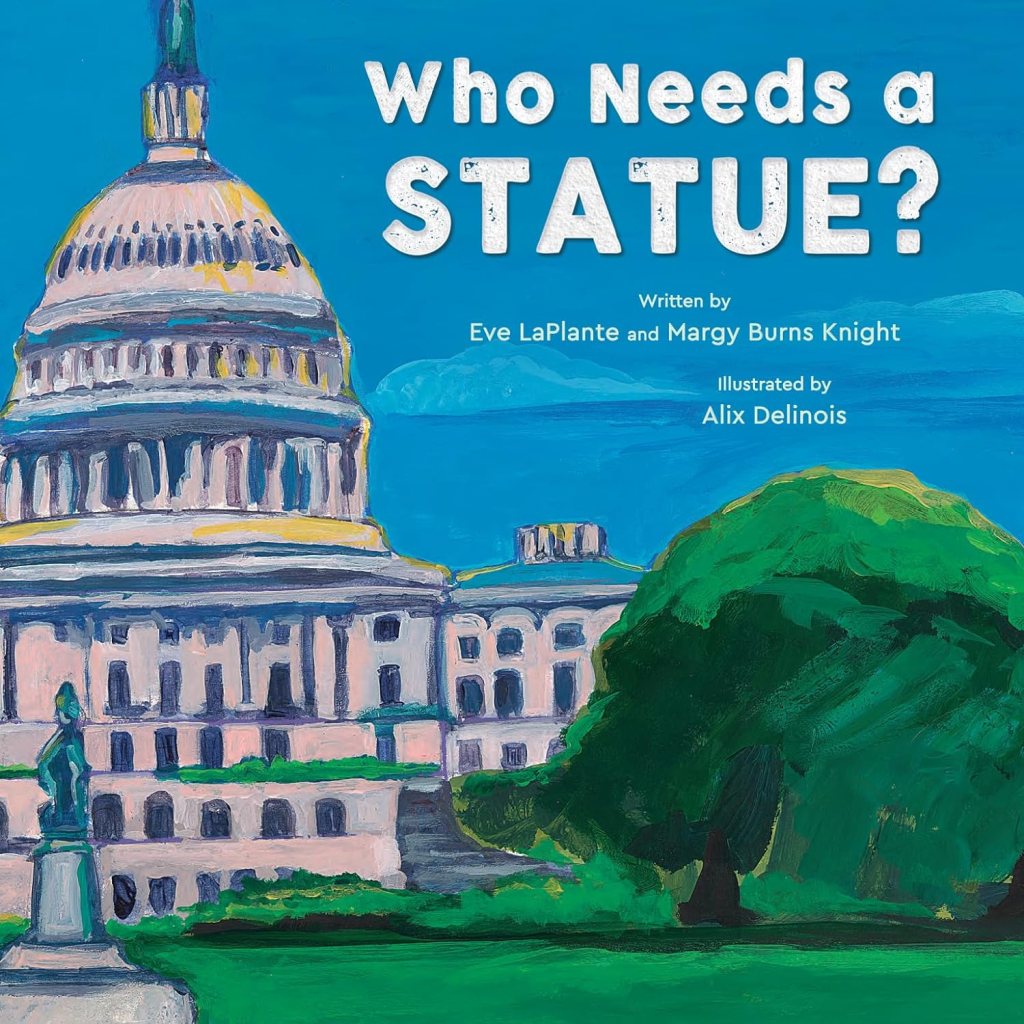
Did you know the U.S. Capitol building features one hundred statues? Each state selects two prominent figures in their history to be included as statues to represent the state in Washington, D.C. But who is chosen to represent this nation? Why are they chosen? And do they really represent this diverse and multifaceted country? This story examines some of the women and BIPOC figures included at the Capitol–and featured in statues around the country–as well as examines the timely question: who needs a statue?
https://www.tilburyhouse.com/product-page/who-needs-a-statue
Did you know the U.S. Capitol building features one hundred statues of important Americans? Each one of the 50 states selects two prominent figures in its history to be included as statues representing the state in Washington, D.C.
How many of the 100 statues are of people of color?
How many are women?
After answering these questions, Who Needs A Statue? tells the stories of amazing women and people of color who are memorialized in statues across the United States.
Coauthored by Eve LaPlante and Margy Burns Knight (Africa Is Not A Country, Talking Walls, and Who Belongs Here?)
With full-color illustrations by Alix Delinois (Eight Days: A Story of Haiti, Mumbet’s Declaration of Independence, and Greetings, Leroy)
Due from Tilbury House Publishers Oct. 15, 2024
Pre order ://www.ddgbooks.com/ or https://oliverandfriendsbookshop.com/
In September 2022, Indigenous activists Nonhle Mbuthuma and Sinegugu Zukulu stopped destructive seismic testing for oil and gas off South Africa’s Eastern Cape, in an area known as the Wild Coast. Organizing their community, Nonhle and Sinegugu secured their victory by asserting the rights of the local community to protect their marine environment. By halting oil and gas exploration in a particularly biodiverse area, they protected migratory whales, dolphins, and other wildlife from the harmful effects of seismic testing.

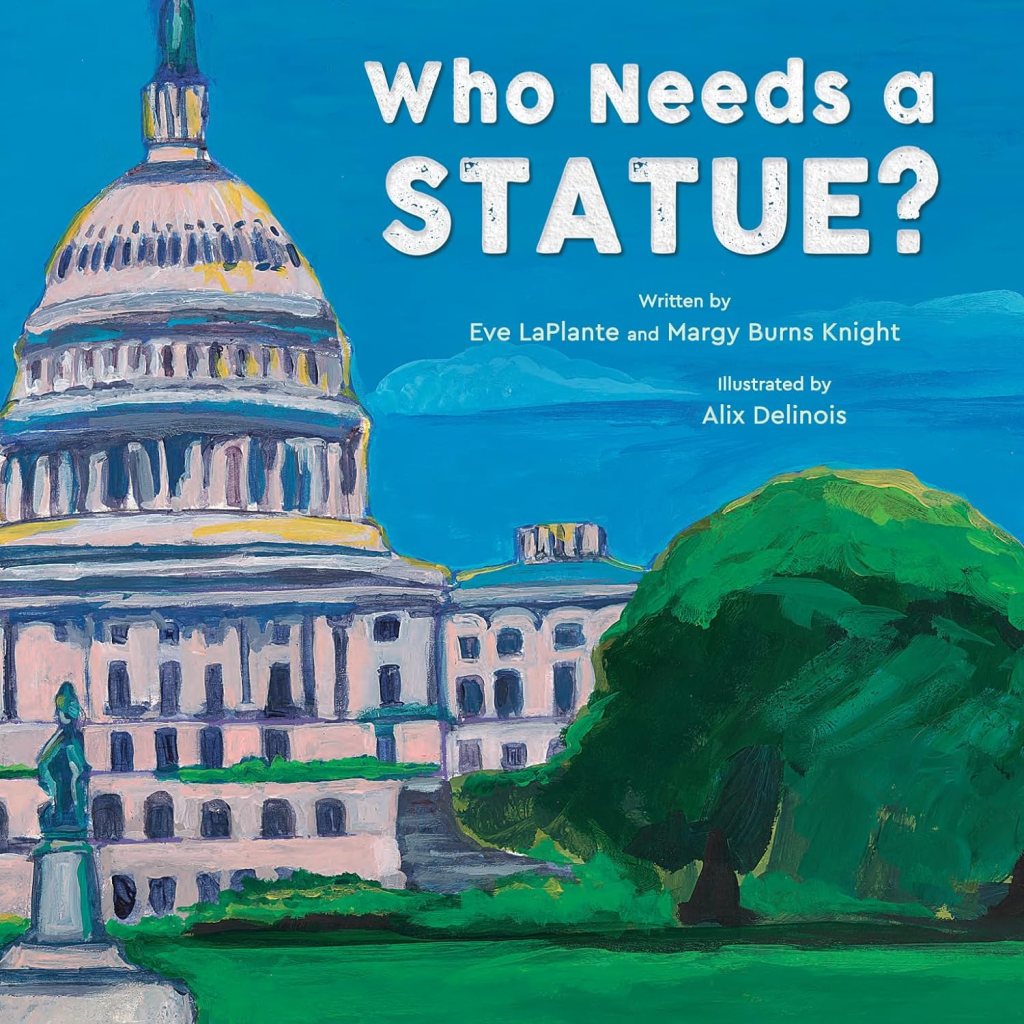
Who Needs a Statue? by Eve LaPlante and Margy Burns Knight, illus. by Alix Delinois,
which takes a look at the historic figures who are not represented in the National
Statuary Hall and explores the idea of who should be immortalized in marble in these
dynamic times
March 18, 2024

By Marie Arana from the New York Times
Ms. Arana is the author, most recently, of “LatinoLand: A Portrait of America’s Largest and Least Understood Minority.” She is Peruvian American.
History is being made on the Rio Grande. Hundreds of thousands of migrants braved the journey across it last year, setting records and contributing to an urgent border crisis. As spectacle, it has been transfixing.
Yet misconceptions abound. It’s as if the sight of a migrant scaling a wall or wading ashore is now a Rorschach test, our Rashomon. Depending on where we sit on the political spectrum, we perceive different truths: Some see a brown “invasion,” others an unremitting drug war, a humanitarian crisis, a political failure, a symptom of societal collapse. The politicizations are legion, and the distortions dire.
More than anything, these images cloud two key realities: Not all migrants crossing the southern border are Latin Americans; Chinese newcomers are now the fastest growing group coming in from Mexico. And most Latinos are not rootless, illegal transients — burdens on the society — as some citizens may think, but a force for American progress.
The majority of Latinos in this country were born here and are English speakers. Some of us have families who inhabited this continent long before the Pilgrims set foot on its shores. Hispanics have fought loyally in every American war since the Revolution. The Army’s eighth chief of ordnance, Brig. Gen. Stephen Vincent Benét, was Hispanic. The first admiral of the Navy, David Farragut (“Damn the torpedoes, Full speed ahead!”), whose commanding statue dominates Farragut Square only steps from the White House, was Hispanic. Roughly one out of every four U.S. Marines today is a Latino. Invasion, indeed.
We are Americans. We have served America since its foundation; we have contributed richly to its culture, its science. Little to none of that history is taught in American public schools; and in the media and entertainment industries, the image of the Latino has historically been roundly negative, if present at all. This, too, needs to change. A vigorous antidote to border fever is in order.
Take the economy. Research has shown that immigrant workers pay taxes and have a net zero effect on government budgets. Whether behind a pupusa stand or a polished desk in a major corporation, Latino workers occupy every rung of the economy and own a considerable stake in the financial success of this country.
Much of that work ethic and entrepreneurship has been spirited for centuries, starting with sixteenth-century traders in the Spanish settlement of St. Augustine, Fla.; or the first Dominican in Manhattan, Juan Rodríguez, who, by 1613, was trading weapons for furs and serving the Dutch as well as the Native Americans. In the 1800s, Mexican vaqueros, the continent’s first cowboys, trained an emerging class of white buckaroos, furnishing them with saddles, 10-gallon hats, chaps and lassos. A century later, during the 1950s and into the 1970s, waves of Cubans and Puerto Ricans arrived on the East Coast, bringing bodegas, paladares (family-run restaurants) and other vibrant Latino enterprises.
Within a generation, Wall Street analysts — and an American president — were marveling at the business acumen of Latinos. But the explosion in the years that followed was even more astonishing. Though Hispanic owners often have difficulty getting financing, in the decade from 2012 to 2022, their small businesses multiplied by 44 percent (more than 10 times the rate of other similarly sized businesses). This is an incursion of a different kind.
Surprisingly, almost 90 percent of immigrant Latino ventures earning at least $1 million a year are owned by millennials (people in their late 20s to early 40s) who came to the United States as youths. That is certainly true for the Argentine businessman Ezequiel Vázquez-Ger and his Venezuelan wife, Mafe Polini, who flew into Washington from their respective homelands when they were 24 years old and began at the bottom of the economic ladder. In time, they dreamed of owning a restaurant, used their savings to help fund their first, and ended up owning six establishments in the capital (one of them earning a Michelin star).
It is also true for José, a Honduran I interviewed for this piece, who asked me to drop his surname because of his undocumented status. After five serial deportations from both the United States and Mexico, José finally crossed the border as a teenager, started work as a lowly bricklayer, and now, at 43 and still without papers, owns his own home in a major American city, as well as a robust plumbing business.
The contributions — by those with families who have been here for centuries and those who arrived only last year — are monumental. Every year, Latino businesses generate about $800 billion for the U.S. economy. Few, if any, entrepreneurial groups in the United States have experienced as much growth.
But that doesn’t tell the whole story. Those small establishments — the housecleaning operations, construction companies, trucking enterprises, beauty shops, ethnic markets and restaurants from Manhattan to Los Angeles — employ millions. Hispanics were responsible for 73 percent of the growth in the U.S. labor force between 2010 and 2020. Today, if Latinos in the United States were their own separate nation, they would represent the fifth-largest G.D.P. in the world.
And yet there is that apparently majority impulse to think that a figure jumping a wall represents us. The lie now supersedes the reality. According to a 2021 poll, Americans of all backgrounds believe that the share of Latinos who are undocumented is more than two times as high as it actually is.
If Latino contributions to the economy are so ubiquitous, if our history on this soil is age-old and honorable, why are those perceptions so skewed? Why are the antipathies so profound? Why do non-Hispanic Americans incorrectly believe that one out of every three of us is deportable?
It’s not just racism. It’s our invisibility. Even as we fill the classrooms, feed the nation and help keep the economy afloat, too often, we are overlooked — unjustly erased from school curriculums, from the media, from corporate boardrooms, from history. Maybe it’s time for America to take a good look.


